Donate now.
Donate with a Credit Card Above
Donate with a Check to:
CCUA
PO Box 1742
Columbia MO 65205
Memo: Kirklin Home Preservation
Donate with Stock or Crypto HERE.
Donate using a QCD/RMD from your IRA. Contact Billy Polansky billyp@columbiaurbanag.org
A group of partner organizations are working together with City of Columbia to preserve and restore the home of Henry Kirklin to eventually provide public access. Several ideas have been discussed for long-term uses for the site and public input will be held in the summer of 2026 to gather more information from the community. We need your help to provide donations to help offset the costs of planning and preservation for this property.
The Kirklin House has a strong connection to Black history in Columbia. It was built ca. 1871 by or for Jane Kirklin, a 51-year-old woman who had spent most of her life enslaved. It served as the longtime home of her son Henry Kirklin, the first Black instructor at the University of Missouri. It is also notable as a rare intact example of 1870s Black-owned housing in Columbia.
Jane Kirklin
Despite being unable to read or write, Jane Kirklin was able to secure freedom for her son and herself around 1863 and become a property owner by 1870. Although she was legally married when she bought the property, the house was in her name only. It was very unusual for married women to own real estate at that time. She bought the lot and had the house built just two years after it became legal for married women of any race to own real property. The property remained in her name until her death in 1878, after which it passed to her youngest son, Henry Kirklin.
Henry Kirklin
The house is best known locally as the longtime home and business office of Henry Kirklin, who was born into slavery in 1858. He received horticultural training working for local nurseryman J. W. Douglass as a youth and secured a job with University of Missouri horticulture department early in his career. He is widely acknowledged as the first Black instructor at that institution. Because Blacks were forbidden to enter university buildings at the time, he taught classes outside. After Kirklin left the university in the 1880s he began purchasing land around this house, eventually creating a prolific commercial garden that covered more than 3 acres on Switzler Street. Henry Kirklin received widespread acclaim for his horticultural skills, including numerous features in agricultural journals, and medals at the St. Louis World’s Fair and the Jamestown Exhibition. The house on Switzler served as his family home and business office until his death in 1938 and the house remained in his family into the 1990s.
Post Civil War Black Housing
The Kirklin house is one of one of very few Reconstruction-era houses left in Columbia, and the oldest one known to have been built for a Black woman. It is in a historically Black neighborhood that covered more than 40 blocks in Central Columbia in the late 19th and early 20th centuries. Although streets in the neighborhood were originally lined with comparable frame houses that were occupied and often owned by Black families, few houses this age have survived. In 1903, for example, there were just over 400 Black residences in Central Columbia; less than ten of those buildings are still standing. Many were destroyed during Urban Renewal, a 1960s program that involved extensive demolition in Columbia’s Black neighborhoods, and a significant drop in Black homeownership.
Local Recognition
In 2019, the house was made a part of Columbia’s African American Heritage Trail, and in 2022 Henry Kirlin was added to the Boone County Hall of Fame. In 2024, the house was listed as one of Columbia’s Most Notable Historic properties for its association with Henry Kirklin. Not long after that, the City of Columbia purchased the property to ensure its preservation. Private fundraising from Columbia Center for Urban Agriculture helped offset the cost of acquisition. Plans are now underway to nominate it to the National Register of Historic Places and find new uses that will include public access to this remarkable link to Columbia’s history.
Current Conditions
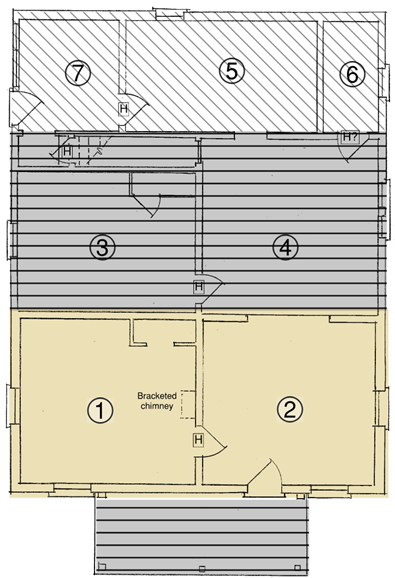
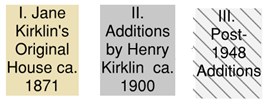
The house has seven rooms. The front two rooms (1 and 2) were built by or for Jane Kirklin in 1870 or 1871. Around 1910, Henry Kirklin and his wife Mattie doubled the size of the house with the addition of two more rooms (3 and 4) and a small stairway to the unfinished attic. They also added the current front porch. Finally, three more rooms (5, 6 and 7) were added sometime after 1948. Those rooms contain the only running water in the house. They have very low ceilings and do not meet modern building codes.